Showing posts with label Amazon. Show all posts

Thursday, February 5, 2026

The risk is always there

Last Wednesday—a week ago yesterday—I read two stories that had nothing to do with each other, except they somehow breathed the same air. In a funny but uncanny way they echoed each other.

Amazon lays off 16,000 employees

One story was widely reported. On that day, Amazon laid off 16,000 workers ... and notified them by accident. You can find the basic story multiple places around the Internet—for example, here. Discussion on LinkedIn (for example here and here) fleshed out some of the details. In principle it is no surprise these days when a tech giant announces layoffs. What was surprising in this case was precisely that Amazon failed to announce them! The layoffs just kind of happened all by themselves, or so it seemed, and then were referenced off-handedly in other, subsequent emails. Finally there was an official announcement (you can read it here), but only after the damage had been done.  Amazon employees shared their experience on Reddit. [Quotes are mostly as-is, and not edited for grammar or spelling.]

I work in SLU. I went to check on my baby at 2am and got and email at 230 that I've been let go. What a great day.... 

i got a txt saying check your personal email before coming to work; work email was disabled. so yeah, break up over txt. 

I didn't know until I got to Blackfoot at 0530 this morning, and my badge didn't work. Tried to slack my boss, and no slack access. Went to email, no email access. After being escorted out of the lobby, got the email in my personal account that my position was eliminated.

Dam I’m at Blackfoot and had to pack up my coworkers stuff.

Again, what's remarkable about this story is not that thousands of people were laid off, but that the communications were handled so ineptly.

Dorx Communications shuts off one account

The second story was a lot smaller. A blogger I follow was moving from Rhode Island to Maryland, and tried to cancel the Internet service at his old lodgings. John Michael Greer tells the story as follows:

In the process of getting all my Rhode Island utilities shut down and all my Maryland ones switched on, I contacted my former [Internet] provider―to keep the lawyers at bay, let’s call the firm Dorx Communi­cations, shall we? You can get almost any other imaginable service from the Dorx website with a few clicks, but shutting off service is a different matter entirely. You have to go to chat, put up with the maunderings of their clueless robot, and get trans­ferred to a supposedly live agent, who then does everything possible to keep you from doing what you’ve come there to do. I slogged patiently through the process, and finally got the allegedly live person to agree that my service would be shut off on January 30.

The moment the chat ended, my phone and internet access shut down. When I walked three blocks to the local public library to get online and contacted Dorx to inform them politely that they’d made a mistake, I found that my shutoff order had been redated to that day, January 18. What’s more, once I was in my account, I was unable to access the chat function at all. It was a pretty obvious middle finger from the dorks at Dorx.

What do these stories have in common?

Both stories involve companies doing something unpleasant. In each case, the company behaves in ways that look to be at best careless and callous; and in each case it is easy to slide from that (admittedly generous) perspective towards one that evaluates the company's actions as "a pretty obvious middle finger." But I have to disagree with Greer. When he reads Dorx's behavior as hostile, he is forgetting an important principle that the Internet calls Hanlon's Razor.

"Never attribute to malice that which is adequately explained by stupidity."

Stupidity is always a risk. It is especially a risk in the actions of corporations, and even more especially in the actions of large corporations. 

But why?

At the most basic level, stupidity is always a risk because we are all human beings, and human beings make mistakes. That's why there is such a discipline as Quality in the first place—to protect against the inevitability of human failure.

Stupidity is a risk in the actions of corporations because many of the "actions" that corporations take aren't based on the decision of any single individual. Multiple people have to work together, often through business processes, and nobody sees the whole picture. Outcomes are the result of the processes themselves rather than of a concrete decision. And if a process is not very well-designed, it can misfire. This is why John Seddon says that his first step working with a new client is to send top management to the front office to watch a single order come in, and then to track that order through its life-cycle. Invariably they learn that the company's systems actually work very differently from how they are supposed to work! (I discuss the point at greater length in this post here.)

And stupidity is especially a risk in the actions of large corporations because those organizations have disporportionately many employees on the inside, where their only contact is with other employees and they are insulated from customers. This means that they are (overall) more likely to trust their business processes than the employees of small companies, because they have fewer opportunities for disconfirmation or falsification.* If unhappy customers can walk into your store and disrupt your day, you are more likely** to take care to keep them happy regardless what the process tells you to do.

Constant vigilance

Of course, at some level everyone knows all this. As noted, the only reason we have a Quality discipline in the first place is that everyone knows people are fallible. But it is important to understand that the most any Quality system can ever do is to help. No system can ever eliminate the risk of human stupidity.

And even the best system can grow flabby and ineffective over time. In earlier posts, I have cited Amazon as a company that strove to avoid bureaucratization. Back in November 2019, Franklin Foer wrote in The Atlantic that "In contrast to the dysfunction and cynicism that define the times, Amazon is the embodiment of competence, the rare institution that routinely works."*** And yet here was Amazon, just one week ago, laying off 16,000 employees without remembering to let them know! 

"The embodiment of competence"? Well, times change. (For other examples, search this blog site for "Boeing.")

Ultimately the only way to avoid stupid mistakes is through constant vigilance. Quality systems can help. Caring about your work makes a huge difference. Paying attention, following through ... all these things are pretty basic. But they are also frighteningly easy to lose track of.

Constant vigilance.   

_____

* In the sense made famous by Sir Karl Popper. See also, for example, this discussion of bureaucracy, which highlights the connection to size.  

** Of course this is no guarantee. Small companies fail too. 

*** Franklin Foer, "Jeff Bezos's Master Plan," The Atlantic, November 2019, p. 58.      


Thursday, July 7, 2022

Bureaucracy and its discontents

A few weeks ago, this column ran a four-part series about whether the proliferation of international standards would undermine economic productivity, under the umbrella title of "Parasitic certifications?" (Part 1, Part 2, Part 3, and Part 4.) Related to this discussion was a question whether the implementation of formal quality standards drives the growth of bureaucracy. 

The short answer is No. Bureaucracy is caused by the overall growth of the organization, and especially by centralization. It is possible to implement a quality system without adding much in the way of personnel, though admittedly you have to be a little clever about it.

To implement a quality system with minimal growth of personnel, you have to incorporate most of the basic quality functions into the daily work of the people doing the operative tasks. There will always be some irreducibly nonzero quantum of administrative work associated, and it is best to give this to someone dedicated to the task. But you don't need someone from Quality to sit in on design reviews, so long as the designers are doing them. You don't need someone from Quality carrying out inspections on the line, so long as you have institutionalized those inspections as part of regular practice. If people know what they have to do and why, you don't need a lot of extra bodies tasked with enforcement.

So what explains bureaucracy? I claim that there are two drivers: growth and centralization.

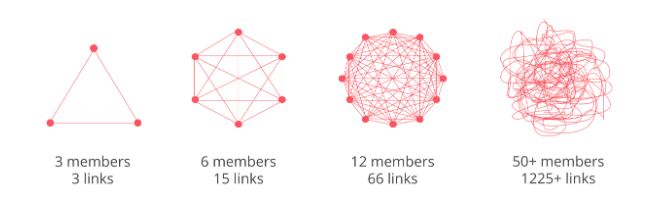
Growth is the first driver, because the more people there are in an organization, the more communication links there are: and the number of links grows as the square of the number of individuals. (In principle the number of links among n people = n(n-1)/2.) 


Bureaucracy is just a tool for managing this communication by slowing it down and channeling it. If you think that bureaucracy makes everything slower and more difficult, well, yes, that's the point. In a large organization the alternative, where internal communication is completely free, would be chaos.

But when I talk about "size," I mean the size of the operational unit, not some larger entity of which it might putatively be a part. There's a video on YouTube where Jeff Griffiths tells a story about working in a team that nimbly exploited their members' multiple competencies, well outside of their job descriptions. It's a story that illustrates some of the larger points he makes regularly about the importance of building and leveraging employee competency. And the organization he was part of, at this time, was the Canadian Armed Forces. Obviously the Canadian Armed Forces are not a small organization. The point is that his team numbered only twelve, and they were out on their own in the middle of nowhere. If the team had numbered 120 and they had been stationed near headquarters, it would have been impossible for them to have worked so adaptively.

In other words, if you belong to a small team which is left alone to do your work in isolation, you can work as a small organization: lightly, quickly, and free of bureaucracy. When you are forced to integrate with a larger entity, that's when you get bureaucracy and your work slows down.

Why would you ever be forced to work more slowly, though?

The process that forces you to integrate with a larger entity is centralization, and there can be a lot of motives pushing centralization.

  • Centralization is cheaper and more efficient than dispersal. If one Purchasing department and one Human Resources department can service five offices, why would you ever pay for five of each?
  • Centralization is simpler than dispersal. It's always easier to deal with one supplier for a given commodity than to manage a dozen. And it's always easier to deal with a few large customers than a hundred small ones.
  • At some level, centralization is simply inherent in the nature of organizations. (The sociologist Robert Michels worked on this topic.)  

To be fair, centralization has its drawbacks, too.

  • Centralization may be cheaper and simpler than dispersal, but it is a lot more fragile. If you have one Purchasing department supporting five offices and that one department loses power, or loses its Internet connection, or is shut down for a pandemic, you could be in a world of hurt. If each office has its own Purchasing agent, one of them can step in to pick up the extra buying, and business can continue.
  • If your single-source supplier goes bust, you have to qualify a new one from scratch. If you have only twelve huge customers worldwide, there's a nontrivial chance that they might all postpone additional purchases during lean times and suddenly you have no income. That's less likely to happen if you have a hundred small customers. 
  • Small organizations are far less likely to suffer from employee disengagement, because everyone can see right away how they personally make a difference. In huge organizations it's a lot easier to put in your eight hours and go home, because the big picture is literally too big for you to see it at all.

So what's the answer? Should companies deliberately try to fail, so they can stay small?

Not quite. But there's a lot to be said for decentralization. Interestingly Amazon — which looks like a global behemoth in anybody's book — has taken some steps in this direction.

One is the famous "two-pizza rule": if a team can't be fed with two pizzas, it's too big. This rule forces teams to be small and manageable.

Another is just as important: the API mandate. This rule seems to have grown out of Jeff Bezos's insistence that "Communication is terrible!" The idea is that every team in Amazon is required to communicate with other teams only through a single API and in no other way. Part of the point was to force Amazon to think in terms of service-oriented architecture. But for our current purposes another consequence was that this mandate reduced the amount of internal communication that was possible at Amazon, and forced it all into highly-predictable channels. That's what bureaucracy is supposed to do. In other words, by (1) forcing teams to be small, and by (2) choking off the (otherwise exponential) growth of communication links, Amazon eliminated the need for the kind of massive bureaucracy that a company of 1.6 million employees worldwide would normally require.

Maybe your company doesn't plan to imitate Amazon. But at least there are options. 


Five laws of administration

It's the last week of the year, so let's end on a light note. Here are five general principles that I've picked up from working ...