Thursday, August 18, 2022

Podcast with Steve Gompertz: "Guerilla Tactics for Quality Leadership"

About a month ago, I listened to a podcast that I really enjoyed. It was an interview with Steve Gompertz, a partner with QRx Partners and a long-time expert in Quality for the medical device industry. And what I loved about the discussion was how much of Gompertz's experience resonated with my own.

The medical device industry is—for obvious reasons—one of the most heavily-regulated industries in the country or the world. My own work has been in less-heavily regulated areas like telecommunications and automotive diagnostics. So I expected to hear about an environment much stricter than any of the ones I'm used to.

But no! What Gompertz learned about working under FDA regulation was exactly what I learned about working under a regimen of central directives in global companies: the structure of rules looks burdensome from the outside, but inside there is actually a fair bit of room to breathe. 

After all, it's not in the interest of the FDA for medical device companies to go out of business. They just want the devices to be provably safe before they are used on human beings. Therefore, Gompertz points out, the FDA largely regulates what you have to do, but leaves it up to you to figure out how to do it. This gives you a lot more leeway than many people realize, leeway that you can use to make regular improvements in your processes and methods. He tells stories of specific changes he made one time or another, which his colleagues were sure the FDA would reject—and the FDA auditor loved them. "Why don't other companies do it this way, when it's so much simpler?"

There's more, but I'd rather let him speak for himself. This, though, is exactly how Quality ought to be done.

Oh wait! Before I forget, Greenlight Guru is hosting an Ask-Me-Anything event with Steve Gompertz in a couple of weeks, on September 7. You can get more information and register for it by following this link here.

And here's the interview.


Thursday, August 11, 2022

"Don't we already know this stuff?"

Over the last couple of weeks I've been discussing why you need to understand the context of your organization (COTO): this means the collection of people who want things from you (your interested parties), the things they want (their requirements and expectations), and any external issues that might affect your ability to get your work done (war, famine, pestilence, zoning regulations, or anything else).

Image by more photos boosty.to/victoria_art_music from Pixabay
And it would be fair for you to ask, "What's the big deal? Don't we already know this stuff? If I don't know what licenses and permits I need, I'm not going to stay in business long. If I don't know what my customers want, I won't have any. Isn't the simple fact that I have customers and I've kept my doors open proof that all this stuff is covered? Why do I need anything more?"

As I say, it's a fair question, and the answer depends on what you are trying to do. If your only purpose is to set up a Quality Management System so that you can get control of your business, you can afford to leave the COTO analysis for later. One day it will be useful, in identifying a list of business risks or in clarifying the exact scope of your system. But those aren't urgent needs. If all you want is to get control of your operations, then yes, the fact that your doors are still open is pretty good evidence prima facie that you can save this topic for later. 

But if you are trying to get or keep ISO 9001 certification, then you have to remember that all these topics are now auditable. While the actual documentation requirements are (as I noted earlier) embarrassingly thin, you have to convince an auditor that you know who your interested parties are, what they want out of you, and all the rest of it. It helps to have something in writing. This requirement was introduced in the 2015 edition of the ISO 9001 standard, and when it came out I went to the General Manager of the organization where I worked at the time. 

"Do you have what you need to be able to answer questions about these things?"

"Well I know what the answers are, but I don't know how I could prove it. The evidence is probably scattered through a dozen emails, some meeting minutes, and maybe a few Post-It notes that I scribbled during phone calls."

So he and I worked with the rest of the management team to set up a way that we could capture evidence of what we were already doing. I had to call a couple of brainstorming meetings to get everyone in the room at the same time. (My budget that year had several entries for pizza.) But the overall impact to the organization was much lower—and the level of acceptance by the organization was far higher—than either would have been if I had announced "There's a brand-new requirement in the ISO standard and we have to start complying with it!"

Yes, in a sense you more or less already know most of your COTO intuitively. But when you have a chance, take a little time to work through it systematically to cross-check what you think you already know. When we went through the exercise (along with all that pizza) we found that we had already covered most of our stakeholder expectations—all but one. And after we looked around the room in shock for a minute trying to figure out how we had missed it, one of the team offered, "Let me take that one. It's the kind of thing I like to do, and it fits in with the rest of what I'm doing anyway." Perfect.


Thursday, August 4, 2022

Context and scope

Last week I talked about how a good understanding of the context of your organization (COTO) can support your identification of business risks, because what business you are in affects what kinds of risks you face. But your COTO does more than that. A well-analyzed COTO can clarify the scope of your Quality Management System as well. 

Silhouette of an octopus
Image by Mohamed Hassan from Pixabay
Some years ago, I audited a service organization that had a very special relationship with their one and only customer. This company provided services to a particular campus of a large, global organization that I'll call Octopus Enterprises. (That wasn't their real name.) But the relationship was close enough that my client's personnel were actually located on the Octopus campus, on a couple floors of one of the buildings. And while the annual contract spelled out that my client was responsible for this and that services specifically, everyone understood that Octopus could ask for something new tomorrow and my client would do it. There might be a discussion about the price, but there would be no discussion about whether to take the job. 

The first time I was there I asked how they defined their management system, and they handed me a Quality Manual which looked exactly like every other Quality Manual you've ever seen. And so I asked the General Manager:

"Why did you write this?"

He said, "I thought we were supposed to have a Quality Manual."

"OK, that was the old edition of the standard and you don't have to any more. But there's a bigger issue. 

"Look, this says you have procedures and follow them. But if Octopus tells you all to 'Jump,' you jump, procedures be hanged. If Octopus tells you all to wear bright green hats to work, you all wear bright green hats to work. It doesn't say that here. 

"I understand that legally you are a separate company. But if Octopus says to do something one day that violates your procedures, you'll do it. And then you risk having me or some other auditor write you up for not following your procedures. 

"For your own protection, you should have something in your management system that explains the relationship, and that says Octopus can override your normal procedures under such-and-such conditions."

I know an auditor is never supposed to consult, but it was important for them to understand this point.

Anyway, that's what I mean when I say that understanding your COTO can clarify the scope of your QMS. Understanding your COTO means you know who wants things from you (your interested parties) and what they want (their requirements and expectations). When you know those things, you also know how much influence these interested parties have over your decisions. If your organization disagrees with a requirement from some interested party, when can you say "No," and when do you have to say "Yes, right away"? If any interested party is important enough that they can affect or override your Quality System, they ipso facto affect your scope and you should make sure to say so. Carefully understanding your COTO is what tells you this.


Thursday, July 28, 2022

Context and risk

A few days ago, I attended another of Christopher Paris's Oxebridge classes.* This one was about using Context of the Organization (COTO) as a tool to address the requirements for Risk-Based Thinking (RBT). The class was entertaining, like all of Paris's classes; but it also had solid content. If you didn't attend the session I did, there's still one more session offered on August 8 and I recommend it.

(No, Chris did not pay me to advertise his class. Do you think I should have asked him to?)

The basic idea behind the class is a simple one, but it's easy to miss: what kind of business you are in determines what kinds of risks you face. If you design medical devices, you face a different set of risks than if you manufacture cars. If you create video games, you face a different set of risks than if you operate a nuclear power plant. This should be obvious.

The reason it's easy to miss is that some organizations skimp on their COTO analysis, because they don't see the point of it. I've audited groups whose COTO analysis must have taken them ten minutes, tops.

Who are your interested parties? Shareholders, suppliers, customers, and society.

What are their expectations? Shareholders want us to be profitable, suppliers want us to pay our bills, customers want good products, and society wants us to offer jobs.

Really? That's it? I probably could have downloaded that list off the Internet too, without even knowing anything about your company.

But organizations get away with this because the documentation requirements for COTO are so thin. ISO 9001:2015 says you have to determine who your interested parties are and what they require of you, but it never says you have to keep records. And so organizations that don't understand the point of COTO do the minimum they think they can get away with, just "to satisfy the auditor." 

On the other hand, if you actually do a thorough job of analyzing your COTO, you can generate a list of your important business risks almost automatically, as a side-effect. Many of these will be topics that you are already aware of, to be sure. But don't be surprised if there are one or two that make you smack your head and ask, "Why didn't we ever think of that one before? It's so obvious now."

Paris's class walks you through how to do this work systematically, and he provides a log file template that is really elegant. It's not the only possible way to organize this information; I've seen at least one other layout I like, which looks rather different. But this one is good, and I'm happy to recommend it. 

If you haven't taken Paris's class yet, sign up for the upcoming session. And even if you pass on the training, spend some time thinking through your COTO. The effort will repay you by giving you clarity on what you are doing today and what you need to do next.    

__________

* I talk here about the last time I attended one of his classes.


Thursday, July 21, 2022

Taiichi Ohno was wrong about profit

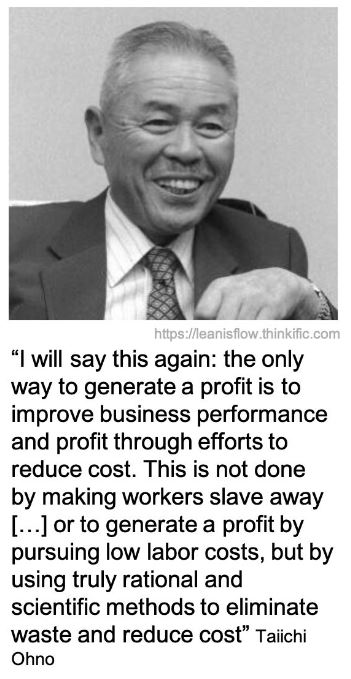
I may get drummed out of the Quality business for disagreeing with Taiichi Ohno, but I can't let this pass. A few days ago, someone published a post on LinkedIn that quoted Ohno as follows:

“I will say this again: the only way to generate a profit is to improve business performance and profit through efforts to reduce cost. This is not done by making workers slave away […] or to generate a profit by pursuing low labor costs, but by using truly rational and scientific methods to eliminate waste and reduce cost.”

Then the OP* went on to talk about Lean.

I have nothing against Lean, and I'm no particular fan of waste. I also recognize that Taiichi Ohno was a very smart man, so I hope this quote was taken out of context. But saying that the only way to make a profit is to cut costs is false. It is foolishness. It is dangerous rubbish.

Here's the problem in three words: costs are finite. Therefore you can only reduce them so far; and soon after you have used all your "rational and scientific methods to eliminate waste and reduce cost," your competitors will do the same thing and you will lose your advantage. Maybe you can eke out a temporary edge doing the things Ohno says to avoid: "by making workers slave away ... [or] pursuing lower labor costs."** But your competitors can do that too. There's no way to win a race to the bottom.

The only guaranteed way to generate a profit is to create value. Offer your customers something they are willing to pay for. Make it different from what the other guy is offering. Make it better. Do something extra, or something new. Whether you are making a product or offering a service, make sure your work has high quality—objective, indisputable Quality—and then charge a fair price for the quality that you are offering.

This is the only side of the equation that is potentially unlimited. 

Of course cost-reduction matters. I'm not denying that. And if Lean helps you make sense your operations, don't let me hold you back. You want to do the most with what you have, and that means working efficiently. Efficiency and systematic methods are good things, to be sure.

My only point is that they are limited. They can only get you so far. Failure to implement efficient methods can keep you from profitability; but efficiency by itself can never make you profitable.

Only value can do that. So create value.

__________

* Original Poster

** The temptation to do exactly this—and thereby to force inhuman conditions on your workers—is specifically why I used the word dangerous in calling this thesis "dangerous rubbish."             

Thursday, July 14, 2022

What do you want me to write about?

Can we take time out for signals?

At this point I've got just about sixty blog posts here since I started publishing a little over a year ago. I've still got some more topics in mind, but I don't know which ones you want to read.

What I have noticed is that some posts are a lot more interesting than others. If I look at the overall view count, it comes out like this:


The really big spike towards the right was this post, which was pure humor. Some of the other often-viewed posts have been about auditing, or about the YouTube video of Steve Jobs talking about Joseph Juran, or about the burning question whether "lying to the public" can be part of your official procedure. But I'm not sure I can tell for sure what the difference is between those posts and some others that generated a lot less interest.

So let me know what's on your mind. What would you like to see me write about? I can keep thinking up topics out of the blue, but if there are things that interest you it's only fair for me to ask what they are and spend some more time on them. What would be helpful?

I'll be happy to hear from you.


Thursday, July 7, 2022

Bureaucracy and its discontents

A few weeks ago, this column ran a four-part series about whether the proliferation of international standards would undermine economic productivity, under the umbrella title of "Parasitic certifications?" (Part 1, Part 2, Part 3, and Part 4.) Related to this discussion was a question whether the implementation of formal quality standards drives the growth of bureaucracy. 

The short answer is No. Bureaucracy is caused by the overall growth of the organization, and especially by centralization. It is possible to implement a quality system without adding much in the way of personnel, though admittedly you have to be a little clever about it.

To implement a quality system with minimal growth of personnel, you have to incorporate most of the basic quality functions into the daily work of the people doing the operative tasks. There will always be some irreducibly nonzero quantum of administrative work associated, and it is best to give this to someone dedicated to the task. But you don't need someone from Quality to sit in on design reviews, so long as the designers are doing them. You don't need someone from Quality carrying out inspections on the line, so long as you have institutionalized those inspections as part of regular practice. If people know what they have to do and why, you don't need a lot of extra bodies tasked with enforcement.

So what explains bureaucracy? I claim that there are two drivers: growth and centralization.

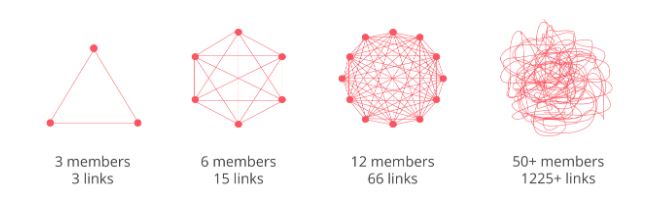
Growth is the first driver, because the more people there are in an organization, the more communication links there are: and the number of links grows as the square of the number of individuals. (In principle the number of links among n people = n(n-1)/2.) 


Bureaucracy is just a tool for managing this communication by slowing it down and channeling it. If you think that bureaucracy makes everything slower and more difficult, well, yes, that's the point. In a large organization the alternative, where internal communication is completely free, would be chaos.

But when I talk about "size," I mean the size of the operational unit, not some larger entity of which it might putatively be a part. There's a video on YouTube where Jeff Griffiths tells a story about working in a team that nimbly exploited their members' multiple competencies, well outside of their job descriptions. It's a story that illustrates some of the larger points he makes regularly about the importance of building and leveraging employee competency. And the organization he was part of, at this time, was the Canadian Armed Forces. Obviously the Canadian Armed Forces are not a small organization. The point is that his team numbered only twelve, and they were out on their own in the middle of nowhere. If the team had numbered 120 and they had been stationed near headquarters, it would have been impossible for them to have worked so adaptively.

In other words, if you belong to a small team which is left alone to do your work in isolation, you can work as a small organization: lightly, quickly, and free of bureaucracy. When you are forced to integrate with a larger entity, that's when you get bureaucracy and your work slows down.

Why would you ever be forced to work more slowly, though?

The process that forces you to integrate with a larger entity is centralization, and there can be a lot of motives pushing centralization.

  • Centralization is cheaper and more efficient than dispersal. If one Purchasing department and one Human Resources department can service five offices, why would you ever pay for five of each?
  • Centralization is simpler than dispersal. It's always easier to deal with one supplier for a given commodity than to manage a dozen. And it's always easier to deal with a few large customers than a hundred small ones.
  • At some level, centralization is simply inherent in the nature of organizations. (The sociologist Robert Michels worked on this topic.)  

To be fair, centralization has its drawbacks, too.

  • Centralization may be cheaper and simpler than dispersal, but it is a lot more fragile. If you have one Purchasing department supporting five offices and that one department loses power, or loses its Internet connection, or is shut down for a pandemic, you could be in a world of hurt. If each office has its own Purchasing agent, one of them can step in to pick up the extra buying, and business can continue.
  • If your single-source supplier goes bust, you have to qualify a new one from scratch. If you have only twelve huge customers worldwide, there's a nontrivial chance that they might all postpone additional purchases during lean times and suddenly you have no income. That's less likely to happen if you have a hundred small customers. 
  • Small organizations are far less likely to suffer from employee disengagement, because everyone can see right away how they personally make a difference. In huge organizations it's a lot easier to put in your eight hours and go home, because the big picture is literally too big for you to see it at all.

So what's the answer? Should companies deliberately try to fail, so they can stay small?

Not quite. But there's a lot to be said for decentralization. Interestingly Amazon — which looks like a global behemoth in anybody's book — has taken some steps in this direction.

One is the famous "two-pizza rule": if a team can't be fed with two pizzas, it's too big. This rule forces teams to be small and manageable.

Another is just as important: the API mandate. This rule seems to have grown out of Jeff Bezos's insistence that "Communication is terrible!" The idea is that every team in Amazon is required to communicate with other teams only through a single API and in no other way. Part of the point was to force Amazon to think in terms of service-oriented architecture. But for our current purposes another consequence was that this mandate reduced the amount of internal communication that was possible at Amazon, and forced it all into highly-predictable channels. That's what bureaucracy is supposed to do. In other words, by (1) forcing teams to be small, and by (2) choking off the (otherwise exponential) growth of communication links, Amazon eliminated the need for the kind of massive bureaucracy that a company of 1.6 million employees worldwide would normally require.

Maybe your company doesn't plan to imitate Amazon. But at least there are options. 


Five laws of administration

It's the last week of the year, so let's end on a light note. Here are five general principles that I've picked up from working ...