Showing posts sorted by relevance for query parasitic certifications. Sort by date Show all posts

Thursday, April 21, 2022

Parasitic certifications? Part 1, The challenge

Just about a week ago, I got a comment on one of these posts that (in a sense) I had been waiting for since I started the blog. The comment, by a reader named Scotlyn, was in response to my post asking whether the Russo-Ukrainian War might bring about the end of the global standardization and certification schema, but it raised issues that go far beyond even as broad a topic as the war. 

As for saying that I've been waiting since the start of this blog, you remember that right in my very first post I explained that my fundamental goal here is to encourage people to talk back to their Quality systems, forcing the Quality systems to justify themselves in ways that make sense. I said I wanted to discuss "what works and what doesn't work" – and I tried to make the point that if a Quality system can't justify itself in rational terms, then we should change it or get rid of it.

This is the challenge that Scotlyn takes up. She suggests point-blank, on the basis of personal experience, that formal Quality systems and formal certification add no value whatever, and are in fact parasitic on productive work. I don't  think I quite agree, but we have all heard people say these things before. If we can't discuss the question honestly and give a decent defense of the Quality business, we can't ask anyone to take us seriously.

Scotlyn's comment is fairly long, so for convenience I'm going to reproduce it here. Then in next week's post, I'll start to answer it. Meanwhile, if you have anything to add to the discussion on your own account, please feel free to comment as well. We can make this conversation as broad and general as it has to be.

So, to begin, Scotlyn wrote as follows:

I have a great personal interest in the theme of standards and certifications, since I worked for many years as compliance officer for a local fish processing company. That is to say, I was the person in the company that interfaced with the global standards and certification industry. By the time I left my job I was convinced of these things:

(1) that the relationship between certified standards and actual quality is fictional. Making the product is one domain that is stubbornly incommensurate with the quite separate domain of documenting, and monitoring compliance with product standards. (in almost exactly the same way as the Tao Te Ching states that the names we can give a thing are not the thing). The standards will never be the products, nor ever be able to satisfactorily describe them.

(2) that, because of (1), it follows that the more standards, the less quality. Standardisation is, in fact, an essential component of the “crapification of things”.

(3) that the relationship between certified standards and the actual economy is parasitic, in that the more jobs that are created to certify, to inspect, to manage, to comply, to produce documentation (including my own entirely non-productive job), the more that productive jobs (the making, transporting of goods, and the providing of services) are destroyed.

(4) that, because of (3), the global standards and certification industry will eventually eat production and the economy, and bring the whole thing to a collapse from too much top-heaviness, and too little bottom sturdiness. Out of which, small, light, and fast non-compliant producers and purveyors who can stay below the radar and out of the limelight, will emerge and begin to create whatever comes next.

I have to tell you that the prospect of a set back to the global certification industry would not cost me a hair’s worry. It contains enough of its own contradictions and unstable weight to collapse without help. Although, to be sure, those employed in its giant documentation fabricating enterprises will resist being made redundant. And it will make thunderous noise as it falls.

On the whole, I'd call that critique pretty thorough. Next week I will take up these points to discuss them. Stay tuned.


Thursday, May 12, 2022

Parasitic certifications? Part 4, Standards eating the world

My last two posts (here and here) discussed Scotlyn's charge that the proliferation of formal standards actually degrades Quality rather than enhancing it. But that is only half of her argument. Her other major point is that jobs in Quality are parasitic on the productive economy, replacing (and thereby eliminating) jobs that make things or add value, and therefore that the Quality business as a whole will ultimately destroy the economy that it lives on.

How far is this true?

Quality as parasite

In a strictly literal sense, of course, it is absolutely true that Quality is parasitic on productive jobs, in exactly the same way that Management is. Neither Quality nor Management is involved in the creation of value (unlike Design, Manufacturing, Logistics, or Service). Both Quality and Management are involved in the organization and monitoring of other people's work. In that sense, they have a lot in common.* 

So the first answer to the charge that Quality is parasitic should be, "Yes, but is that a problem?" If told that it is, we should pursue the analogy with Management to understand why it is a problem. Scotlyn expresses concern that Quality jobs can push out productive jobs, by consuming the resources that would otherwise have paid for them. In the same way, there are some companies where the members of Management assign themselves a disproportionate share of the proceeds, so that the firms cannot pay their other bills and go belly up. We know this sometimes happens, but nobody thinks that such failures invalidate the general concept of Management. All they prove is that — as a manager — you can't afford to get greedy. While it is possible for Management to ruin the enterprise, the answer is to do a better job of implementing Management, and not to do away with it altogether.

Does the analogy hold? I think it does. I have argued before in support of clerical staff, because they offload important work from people who should really be doing something else. And I propose that the same thing is true of Quality staff. Somehow there is an optimal level of administrative functions (by which I mean management, quality, and clerical work all bundled together) — in other words, a level at which the organization flourishes. With too few people in these functions, the organization trips and falls because there is no infrastructure to clear simple obstacles out of the way;** with too many, the organization chokes on its own bureaucracy and runs out of money by paying too many unproductive salaries. Somewhere in the middle has to be a Goldilocks point where the size of the administrative staff is just right.   

That, then, is what we should do. That is how we should implement Quality systems. And as you may have noticed, that has been the approach I have tried to advocate throughout this blog. But Scotlyn makes one final argument: regardless what we should do, she predicts, in fact "the global standards and certification industry will eventually eat production and the economy, and bring the whole thing to a collapse from too much top-heaviness, and too little bottom sturdiness."

Is she right?

Eating the world

The answer depends partly on the number of new global standards that are written, and partly on the number of industries that make them mandatory. On the first point, I think she may be on the right track; on the second, I am a little more sanguine.

What encourages the proliferation of standards is that there are no known limits on the number of things that can go wrong. And whenever something goes wrong, the easiest solution is to make a rule so that it can't happen again. So I see no obvious reason why the number of global standards — the number of rules — should ever level off, until the day comes when our whole current economic system turns obsolete and is replaced by something else that we can't imagine today.

Of course the problem with reflexive rule-making is that the first time you do it, you look decisive. After the twentieth time, you start to wonder whether you have unintentionally tied yourself in knots.   

Bear in mind, though, that any company which hires too many people into non-productive functions will sooner or later go bust. This is why I say I am more sanguine about the question how many industries will make these standards mandatory. In industries with wide profit margins — like aerospace, aviation, or the high-technology industries generally — we should expect global standards to be ubiquitous, because those industries can afford them. But in other industries, those with narrower profit margins, I think we can expect that standardization will get next to no foothold at all, because none of the firms in those industries can afford to hire the personnel. In other words, after the highly profitable industries are saturated with global standards, I tend to think that the spread of standardization will slow or stop. This may help to postpone the collapse that Scotlyn foresees. 

Thunderous noise

If Scotlyn is right — if the whole system does collapse and "make thunderous noise as it falls" — will that really be a problem?

For those of us with jobs in the Quality industry, it will likely mean unemployment. At a personal level, yes, that generally counts as a problem. But for the rest of the world?

It would be a serious setback to global trade if buyers and sellers stopped using uniform weights and measures, or if the specifications for ball bearings and light-bulb sockets were no longer reliably standard around the world. But those standards are the least likely to be abandoned, for exactly that reason.

It would be nice to think that some acceptable level of safety standards for food and appliances will remain in force internationally, but I don't know enough to make an argument that it's certain. Maybe it's not certain, and — if true — that would be a sad fact.

As for the management system standards, the ones that I know best, these would probably trigger the least immediate harm if they suddenly vanished. (For professional reasons, naturally I wish I could say otherwise. But no such luck.) In that sense, they are probably the most optional of the lot. If the global system of standardization collapses, the best case for the management system standards is if they remain as guidelines to best practices for managing organizations. That way, at least they could still benefit organizations who chose to implement them, even if external certification were no longer available or meaningful.

Summary

Where does this leave us? Let me summarize briefly the main points of Scotlyn's argument, and my replies to each, in order:

  • "The relationship between certified standards and actual quality is fictional."
    • It is certainly non-deterministic.
  • "The standards will never be the products, nor ever be able to satisfactorily describe them."
    • True.
  • "It follows that the more standards, the less quality. Standardisation is, in fact, an essential component of the “crapification of things."
    • Not so fast. Some level of standardization has its place — e.g., for critical health and safety aspects.
    • Also the management system standards are valuable guidelines to good basic business practices.
    • But yes, there is certainly a risk that too much standardization can undermine product quality.
  • "The relationship between certified standards and the actual economy is parasitic, ....
    • True. Just like management, no more and no less.
  • "... in that the more jobs that are created to certify, to inspect, to manage, to comply, to produce documentation ..., the more that productive jobs ... are destroyed."
    • Yes, all true. 
    • But some non-zero number of administrative and Quality jobs are needed to allow the organization to function. 
    • The key is to find the magic Goldilocks number, and the great trick is never to exceed it.
  • "The global standards and certification industry will eventually eat production and the economy, and bring the whole thing to a collapse from too much top-heaviness, and too little bottom sturdiness."
    • There are forces pushing in this direction, and others pushing against it. I don't know which forces will win. But you might be right.
  • "Out of which, small, light, and fast non-compliant producers and purveyors who can stay below the radar and out of the limelight, will emerge and begin to create whatever comes next."
    • From your lips to the ears of Heaven. 
Answering Scotlyn's remarks has been my longest single exercise of analysis and exposition since I started this blog, and I thank her — deeply and sincerely — for pushing me to do it. At the same time, I am well aware that other readers might disagree with some (or all!) of what I have written here. As always, please add your comments so we can make this a living discussion. The only way we can achieve continual improvement in our theory and practice of the Quality business is to talk to each other.

As always, let's talk.             

__________

* As an aside, I note that I've heard complaints about the uselessness of Quality far more often than I have heard the equivalent complaints about Management. I'm not sure why.   

** In The Restaurant at the End of the Universe, Douglas Adams characterizes this extreme as the point at which the entire Golgafrinchan population dies off from an infectious disease contracted from an "unexpectedly dirty" telephone.


Thursday, April 28, 2022

Parasitic certifications? Part 2, The crapification of things

In last week's post, we looked at a broad and fundamental criticism from a reader named Scotlyn, indicting the whole system of global standardization and certification as (in essence) fraudulent and parasitic. Now I want to examine each of Scotlyn's points carefully, to see how far I agree with her. 

Please note that I actively encourage your participation too. Add your feedback in the Comments. Tell us what you think.

Scotlyn's first charge is that "the relationship between certified standards and actual quality is fictional," and that "it follows that the more standards, the less quality." Is this true?

There are two sides to this charge, which I want to treat separately: product standards, and management system standards. I will discuss product standards here, and management system standards next week.

Part of the difficulty in discussing product standards is that many of the most basic ones have become so ubiquitous in the industrialized world that they are almost invisible. I'm thinking of the kinds of basic safety standards for food or equipment that were unheard-of 150 years ago but that we take for granted today. Whatever else might be said for or against the modern meatpacking industry, for example (and it is not a specialty of mine), I'm pretty sure that practices are more sanitary than they were back when Upton Sinclair wrote The Jungle. You can probably think of other examples on your own. And I assume that nobody will argue for abandoning the most basic safety standards, except perhaps as a rhetorical exercise. But as the number of product standards proliferates, we begin to see at least two problems. 

The first problem is that each standard imposes constraints on the design of a product, and requires some non-zero fraction of the designer's attention. The more standards there are, the more of the designer's attention has to go into meeting basic requirements, leaving less attention available to put towards the inherent quality of the design. The only way to counter this effect (to the extent that it can be countered at all) is to take longer designing the product. Once upon a time, maybe it took a month for a small team at WidgetCorp to design and test a really good widget. But after the introduction of a lot of Mandatory Widget-Industry Standards, it might take twice as long to design the very same widget. The designers now have to read all the standards, and confirm that their design meets them in theory; and then testers have to run tests for every single standard to make sure each one has been met. The end result might not be any different from what it would have been otherwise, although the team will know a lot more facts about the product than they would have without the standards, and they will have recorded all those facts in a huge stack of documents. But all this work takes time and effort, with the result that WidgetCorp now takes twice as long to bring a new widget to market, and charges twice as much for them to recoup the added development costs. And as a direct result of this hefty increase in time and cost, ....

The second problem is that a competing manufacturer (Fly-By-Night Widgets) will enter the market designing widgets that strictly comply with the standards, but that are in other respects as slapdash as possible. With this approach, Fly-By-Night brings out their widgets faster than WidgetCorp does, and sells them for cheaper. And we all know that  other things being equal  the market favors whichever competitor is faster and cheaper. After a while, Fly-By-Night drives WidgetCorp out of business, and the market is saturated with widgets that comply with standards but are otherwise worthless. This long-term process is what Scotlyn describes as the "crapification of things." (See also this Dilbert cartoon for a summary of the same observation.)

Is there a solution to this dynamic? At a theoretical level and in the general case, no, I don't think so.* I believe the best we can hope for is one or another pragmatic settlement.** By a "pragmatic settlement," what I mean is two things. 

  • First, some companies will continue to make products which are so obviously superior that customers will willingly pay more for them. (I once audited a VP of Sales who said his department's whole job was to explain to potential customers why they should pay five times as much for one of this company's products as for a competitor's. Mostly they succeeded in doing so.) 
  • Second, maybe we can come to some kind of agreement around a basic level of standards (for, e.g., health and safety) which clearly represent a bare minimum  maybe we can agree not to sell laudanum as a cure for a broken leg, for instance   and then stop there. If it were clear that "meets standards" is not the same as "good enough," we might be able to hold back the threat of encroaching crapification, at least for a while.

Or perhaps this answer isn't good enough, in which case I invite your contributions. How would you address the conundrum? 

Next week I'll talk about management systems.

__________

* Or if there is a solution, it involves modifying some of the assumptions behind this description (for example, the principle of economic competition) in ways which are far beyond the scope of this blog and even farther beyond my competence as an author.

** For the distinction between solutions and settlements, see Bertrand de Jouvenel, The Pure Theory of Politics, "Addendum: The Myth of the Solution."      


Thursday, May 5, 2022

Parasitic certifications? Part 3, Certified systems vs. quality

Just as a reminder, I am still discussing a broad-based critique of Quality standards and certifications from Scotlyn, a reader whose fundamental challenge you can find here

Scotlyn began by arguing that "the relationship between certified standards and actual quality is fictional," and that "it follows that the more standards, the less quality." Last week I discussed whether and how far I can support this critique with respect to product standards. In what follows below, I address management system standards.

How far the charge is true

When we turn to management system standards, it is certainly true that certification to a quality management standard like ISO 9001 does not guarantee all your products are good. Just following the right rules won't give you Quality.

In the same way, it is perfectly possible for a company to turn out excellent work, on a reliable and repeatable basis, without ISO 9001 certification. I once worked for a small regional outpost of a huge, global company. One of our regular suppliers — a firm we had worked with for years — was not certified to ISO 9001. Our global headquarters issued a directive that no company could be rated as a Preferred Supplier unless it met a variety of criteria, including certification. At first our local Purchasing Manager tried to protest that this was the only supplier from whom we had never had a major problem — and even when there were minor issues they were always perfectly responsive. Headquarters was unmoved; the regulation had to be implemented worldwide, with no exceptions. So our local Purchasing Manager dutifully categorized this supplier as "Non-Preferred," and then went right on ordering from them exactly as before. I joked that we should have a special category for "Non-Preferred Suppliers That We Like a Lot."

But I almost think this supplier counts as a special case, rather than a simple counterexample against ISO 9001. It was obvious to anyone who did business with them why their work was so consistently excellent. This was a family firm owned by a man who had put everything into it, and who identified with it totally. He was personally committed to flawless workmanship, most of the employees were relatives, and nobody was willing to let down the family. It was a powerful combination, but not one that many companies are in a position to imitate.

This is one reason, though, that I have spent some of my time in this blog posting about topics like employee engagement, competence and attitude. While management systems are important, no system can do all the work by itself. So I have been happy to highlight the work of specialists like Jeff GriffithsDawn Ringrose, and Angie Alexander, who study and teach ways to encourage that personal connection between the people doing the work and the felt desire to do it right.

That said, this forum is primarily about Quality systems. And I'm not prepared to write them off yet.

In what ways the charge is false

In the first place, most of the requirements of a standard like ISO 9001 are little more than formalized common sense. With a standard or without it, companies that don't keep meeting minutes or do design reviews will have trouble sooner or later. And while it catches our attention when we see an uncertified company doing flawless work or a certified company shipping garbage, the times that quality and certification align are less striking — precisely because they are more expected — and therefore harder to see. But we have to take account of that side of the ledger as well.

I've worked in startups where there are no systems in place. They are energetic and creative places; the ones where I worked made solid and useful products. And normally everyone got along fine without a lot of system overhead. But when something went wrong, nobody knew how to react; when an unexpected bug brought one of our software products crashing to the ground, nobody knew where to find it, because the code wasn't modular and there had been no unit testing. I don't say that ISO 9001 by itself made all our problems go away. But the introduction of some kind of system was key to making them more manageable. And ISO 9001 is a perfectly decent framework for the kind of system I mean. (Note that ISO 9001 is only a framework. You still have to design your own system for yourself, or hire someone to do it for you. But ISO 9001 tells you what kind of shape it should have when you are done.)

Another story

Here's another example, and maybe a deeper or richer one. Recently I was talking with a woman who owns a small, local business that fills a very specialized niche. In her line of work, certification is now effectively mandatory: if you aren't certified, you have no customers. But it wasn't always so, and she has been in business long enough to remember the changeover. She told me that when certification became available — and then mandatory — it was a huge help to her because it enabled her to require a wide range of good practices that she had wanted for a long time but had been unable to implement effectively. Suddenly she didn't need to listen to any Good Reasons™ from her employees about why this or that practice would never work; her answer to all of them was, It has to be done by the time the auditor gets here, or we fail the audit and go out of business. Discussion closed. Then as she continued to reminisce, she casually mentioned that before certification became a requirement she knew of 250 small companies just like hers doing the exact same kind of work; then, as certification became mandatory, the owners of 100 of them decided that the burden imposed by certification was too much for them in either time or money, so they closed their doors. When the dust cleared, a field of 250 small businesses had shrunk to 150, a loss of 40%.

The reason that I call this example deeper or richer than the first one is that it makes two points very clearly.

On the one hand, the imposition of a Quality system has to potential to improve a business in a meaningful way. Potential to improve. No Quality system will ever guarantee that a company becomes good; but it can in any event make the company better than it was before. And sometimes that's a great achievement anyway. Moreover, as always, the standard does nothing by itself; it does nothing without the engagement and support of the people using it. The value comes when the systematic approach required by the standard becomes second nature, when it is fully incorporated into a company's way of working. If some company just wants to game the system so that they can get a certificate without having to change, they might be able to get away with it for a little while (probably not forever). There is no system in the world that cannot be gamed. But that fact is less a reflection on the standard and more a qualification of what the certificate means.   

On the other hand, nothing in life is free. Implementing and maintaining a Quality system requires effort. That effort costs money, because you have to pay somebody to do it; and it costs time, because that person can't do something else while working on this. You surely can't ask your existing staff to implement a Quality system on top of their regular jobs without affecting their productivity. 

This last point is entirely valid. It is important. And it leads us directly into Scotlyn's next charge, which I will take up next week.


Thursday, July 7, 2022

Bureaucracy and its discontents

A few weeks ago, this column ran a four-part series about whether the proliferation of international standards would undermine economic productivity, under the umbrella title of "Parasitic certifications?" (Part 1, Part 2, Part 3, and Part 4.) Related to this discussion was a question whether the implementation of formal quality standards drives the growth of bureaucracy. 

The short answer is No. Bureaucracy is caused by the overall growth of the organization, and especially by centralization. It is possible to implement a quality system without adding much in the way of personnel, though admittedly you have to be a little clever about it.

To implement a quality system with minimal growth of personnel, you have to incorporate most of the basic quality functions into the daily work of the people doing the operative tasks. There will always be some irreducibly nonzero quantum of administrative work associated, and it is best to give this to someone dedicated to the task. But you don't need someone from Quality to sit in on design reviews, so long as the designers are doing them. You don't need someone from Quality carrying out inspections on the line, so long as you have institutionalized those inspections as part of regular practice. If people know what they have to do and why, you don't need a lot of extra bodies tasked with enforcement.

So what explains bureaucracy? I claim that there are two drivers: growth and centralization.

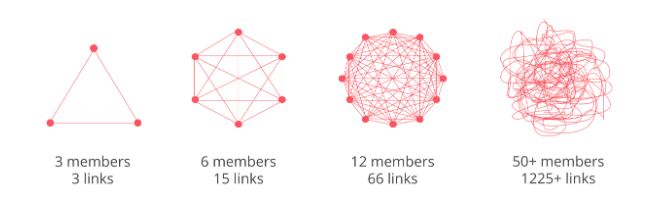
Growth is the first driver, because the more people there are in an organization, the more communication links there are: and the number of links grows as the square of the number of individuals. (In principle the number of links among n people = n(n-1)/2.) 


Bureaucracy is just a tool for managing this communication by slowing it down and channeling it. If you think that bureaucracy makes everything slower and more difficult, well, yes, that's the point. In a large organization the alternative, where internal communication is completely free, would be chaos.

But when I talk about "size," I mean the size of the operational unit, not some larger entity of which it might putatively be a part. There's a video on YouTube where Jeff Griffiths tells a story about working in a team that nimbly exploited their members' multiple competencies, well outside of their job descriptions. It's a story that illustrates some of the larger points he makes regularly about the importance of building and leveraging employee competency. And the organization he was part of, at this time, was the Canadian Armed Forces. Obviously the Canadian Armed Forces are not a small organization. The point is that his team numbered only twelve, and they were out on their own in the middle of nowhere. If the team had numbered 120 and they had been stationed near headquarters, it would have been impossible for them to have worked so adaptively.

In other words, if you belong to a small team which is left alone to do your work in isolation, you can work as a small organization: lightly, quickly, and free of bureaucracy. When you are forced to integrate with a larger entity, that's when you get bureaucracy and your work slows down.

Why would you ever be forced to work more slowly, though?

The process that forces you to integrate with a larger entity is centralization, and there can be a lot of motives pushing centralization.

  • Centralization is cheaper and more efficient than dispersal. If one Purchasing department and one Human Resources department can service five offices, why would you ever pay for five of each?
  • Centralization is simpler than dispersal. It's always easier to deal with one supplier for a given commodity than to manage a dozen. And it's always easier to deal with a few large customers than a hundred small ones.
  • At some level, centralization is simply inherent in the nature of organizations. (The sociologist Robert Michels worked on this topic.)  

To be fair, centralization has its drawbacks, too.

  • Centralization may be cheaper and simpler than dispersal, but it is a lot more fragile. If you have one Purchasing department supporting five offices and that one department loses power, or loses its Internet connection, or is shut down for a pandemic, you could be in a world of hurt. If each office has its own Purchasing agent, one of them can step in to pick up the extra buying, and business can continue.
  • If your single-source supplier goes bust, you have to qualify a new one from scratch. If you have only twelve huge customers worldwide, there's a nontrivial chance that they might all postpone additional purchases during lean times and suddenly you have no income. That's less likely to happen if you have a hundred small customers. 
  • Small organizations are far less likely to suffer from employee disengagement, because everyone can see right away how they personally make a difference. In huge organizations it's a lot easier to put in your eight hours and go home, because the big picture is literally too big for you to see it at all.

So what's the answer? Should companies deliberately try to fail, so they can stay small?

Not quite. But there's a lot to be said for decentralization. Interestingly Amazon — which looks like a global behemoth in anybody's book  has taken some steps in this direction.

One is the famous "two-pizza rule": if a team can't be fed with two pizzas, it's too big. This rule forces teams to be small and manageable.

Another is just as important: the API mandate. This rule seems to have grown out of Jeff Bezos's insistence that "Communication is terrible!" The idea is that every team in Amazon is required to communicate with other teams only through a single API and in no other way. Part of the point was to force Amazon to think in terms of service-oriented architecture. But for our current purposes another consequence was that this mandate reduced the amount of internal communication that was possible at Amazon, and forced it all into highly-predictable channels. That's what bureaucracy is supposed to do. In other words, by (1) forcing teams to be small, and by (2) choking off the (otherwise exponential) growth of communication links, Amazon eliminated the need for the kind of massive bureaucracy that a company of 1.6 million employees worldwide would normally require.

Maybe your company doesn't plan to imitate Amazon. But at least there are options. 


Thursday, June 23, 2022

What is Quality in government?

A couple of days ago, I started a conversation with Dawn Ringrose on LinkedIn, about the role of Quality in government. Dawn, you may remember, is the founder and principal of Organizational Excellence Specialists. She and her team of experts study and teach a set concrete behaviors that improve business performance, and I have referenced her work in earlier posts, for example here and here.

Anyway, our discussion began when she recommended a book (Democracy in Canada) by Donald J. Savoie highlighting issues in some of Canada's governmental institutions and proposing remedies. At the same time, she referenced an hourlong talk of his, available on YouTube, which summarizes some of the themes in his book. I haven't read the book yet, but I watched the speech. What I found fascinating was the way that Savoie's speech and my subsequent discussion with Dawn kept echoing topics we have already discussed here in other contexts.

One point that Dawn made early on was the following: "In my experience, I have found the most difficult question for people working in government to answer is 'Who Is Your Customer'? To me, this speaks volumes." And of course it is clear that if you don't know who your real customers are, you can't possibly understand what it means to satisfy them. In that case, how can you tell whether you are doing a good job?

But I think it is equally clear why the question might be baffling for someone working in government service. Think of all the different people who might have a legitimate claim to the title of "customer":

  • The member of the public standing right in front of you, who has brought you a problem and is asking for help. This might seem to be your "customer" in the sense of service, but he's not the one paying for the service.
  • The Taxpaying Public as a collective whole. These are the people paying for the services you offer, but it's hard to ask them all what they actually want from you. What is more, they likely don't agree with each other. (That's part of why we have governments in the first place.)
  • The elected government* who are constitutionally presumed to speak on behalf of the Taxpaying Public. This means the Prime Minister and the Cabinet, at any rate until there is a vote of confidence or another general election.
  • Your immediate superior in the civil service bureaucracy. This is the one person that you clearly have to satisfy to avoid getting the sack. But then who is your boss's customer?

We've seen this exact problem before, in our discussion whether you can ISO-certify a university. At that time we examined several contenders for the title "customer of the university," including: the students themselves, their parents, their future employers, regional governments (to the extent that they subsidize some or all of the educational process), and society-at-large. All of them get some benefit from universities, but the alignment between "Who gets the benefits?" and "Who pays the costs?" is pretty rough. At the time we concluded that maybe the best solution is to use the language of ISO 9001:2015 and call them all "interested parties" (i.e., stakeholders) without trying to get more precise. And maybe that's the right answer when talking about governments too.

But it doesn't stop there. One point that Savoie makes at some length in his speech is that there have been multiple initiatives** to encourage public institutions to learn from the management of private ones, and that the main consequence of these initiatives have been a proliferation of metrics and reports; but (he goes on) the metrics don't measure anything useful, the reports go unread, and the only practical consequence is a slow degradation of the organization's ability to perform. 

Does this sound familiar? It should. Whenever you implement a system of monitoring and measurement, there is always a risk of measuring the wrong things. And my recent exchange with Scotlyn on parasitic certifications included a discussion of her charge that jobs in monitoring and certification will progressively drive out jobs in production [or service, as the case may be] until Quality eats the world. In theory there is some kind of brake on this behavior in for-profit organizations, because when the Quality overhead gets too large it starts to affect the bottom line; and at that point the organization presumably cuts back. I won't claim that there are no such brakes in government service, because departments are given budgets and expected to adhere to them. But in any event the braking function must look very different.

Can governments benefit from the application of Quality expertise? Of course they can. We in the Quality field—and in Quality-adjacent fields like Excellence—specialize in understanding how organizations can go wrong and what it takes to set them right. In this sense our work applies to any kind of organization whatever. But we have to apply our expertise pragmatically, and we have to be aware of the ways in which public service is different from private enterprise. Next week I'll look at a few of those differences.   

__________

* Using the word in a parliamentary sense.  
** Savoie is specifically talking about the Canadian federal government, though I have no doubt the same thing has been done elsewhere too.         

Thursday, April 18, 2024

Is Quality a "value-added" activity?

Does Quality add value?

When I was researching my posts about Boeing this spring, I ran across several sources who said Boeing had been cutting back Quality activity for years, on the grounds that Quality work was merely "overhead" and not "value-added."* So even though I've touched on this topic once or twice before,** maybe it's useful to review the question again.

It should be no surprise that I think Boeing was wrong to say that Quality doesn't add value, but in a sense they were on to something. There are two fundamental ways in which Quality differs from components like wheels or doors:

  1. Quality is not tangible or material. Quality isn't a What, but a How.
  2. Quality depends on the user. Quality means getting what you want, and different people want different things. So it's easy to think that Quality isn't objective.

The first point means that there's no container in inventory labelled "Quality." You can't reach in and pull out half a kilogram of Quality to install in one of the engines. Whether you build an airplane with or without Quality, mostly you use the same parts and the same tools. The difference is in how you use them. Do you really need to pay Quality personnel for that? Isn't Quality free

Well no, it's not. We've discussed this before. People make mistakes. The way to prevent those mistakes is to put systems in place. The systems will save you money in the long run (because you won't be paying for warranty repair or liability lawsuits), but they still cost you in the salaries of the people who run them. It's just cheaper to pay your Quality personnel a predictable sum now, than it is to pay angry customers and victorious plaintiffs incalculably more at some unexpected time in the future.

The second point is easier to explain with an example. Suppose one of Boeing's airplanes is still around far in the future, and is discovered by a band of scavengers crossing a post-apocalyptic hellscape. They won't care about the precision machining that went into the parts, nor about the multiple fail-safe systems that keep the plane in the air. All that will matter to them is that the airplane can be torn apart for scrap metal. So that precision machining will add no extra level of Quality from the perspective of the scavengers. They won't find Quality anywhere as they rip the plane apart. Doesn't that mean that Quality is subjective? 

Of course not. The answer is that Boeing's actual customers aren't scavengers in a post-apocalyptic hellscape. Boeing's customers are airlines, all of whom want the same thing—namely, to satisfy their own customers. For their part, the airline customers want to get where they are going safe and sound, and more or less on time. In cases like this, where everyone wants the same thing, Quality is absolutely objective. Anything that makes an airplane easier to fly and safer in the air is part of Quality. Anything that makes it more difficult and more dangerous is Wrong, and has to be avoided! 

All the same, I can see how these two points could mislead the Boeing management. When Harry Stonecipher took over Boeing, he avowedly set out to shift the company's focus from engineering to business. But that means that management had to focus on what was tangible and objectively quantifiable: we've all heard the admonition, "You can't manage what you can't measure." And so, ineluctably, the business focus on strict measurables with a visible impact on the bottom line meant that management had no alternative but to pay less attention to Quality.

Boeing is going through a lot of very public troubles right now, so maybe we shouldn't focus on them too relentlessly. Let's look elsewhere. Can we find other areas where Quality—an intangible that relates to customer experience and customer preferences—adds a value that people are willing to pay for?

Yes. Everywhere.

Sometimes it's not quantifiable, but it's still real. There is an old saying in sales, "Don't Sell The Steak, Sell the Sizzle." The point is that—mostly—nobody cares nearly as much about the composition of a product as they care about their experience of it. You can't eat the sizzle, but that's what people pay for. More generally, people pay for experiences that make them happy; the only time that they pay for specific physical components are when they believe that those specific components are necessary to achieve their happiness.*** But their experience, their happiness, is not tangible; and in principle it can change from one customer to another. In other words, customers pay for Quality, and not for things.

It also happens that sometimes people pay for Quality in a way that is very quantifiable! I once had an employee who used to work for a company that made medical implants. And he told me that on his very first day, his boss sat him down to say:

We sell plastic devices that cost us $5. We sell them for $125. The extra $120 pays for Quality! So don't mess it up.

Yes, Quality adds value. Sometimes you can measure it in dollars. Even when you can't, it is absolutely real.  

__________

* See for example "The last days of the Boeing whistleblower" from Fortune, March 16, 2024 (especially the next-to-last paragraph), or the On Point Podcast from NPR titled "Whistleblowers, an executive shakeup, and the future of Boeing" (especially from about 11:20 to 11:40). 

** See for example the series "Do audits really add value?" in 2021 (parts 1, 2, and 3), and the series on "Parasitic certifications?" in 2022 (parts 1, 2, 3, and 4). Or just search the blog for the phrase "value add."  

*** And sometimes this is obvious. If I drive over a nail that punctures my tire, the only thing that is going to make me happy is a new tire with no holes in it.        


Five laws of administration

It's the last week of the year, so let's end on a light note. Here are five general principles that I've picked up from working ...